When you need a permit, what the county charges, and what to ask when damage goes beneath the shingles.
Each figure comes with the date we gathered it. If the source leaves something unclear, we say so beside the figure.
Do you actually need a permit?
The permit question comes down to what you are repairing. Is it the roof covering or the structure beneath it? Describe both to Howard County's Department of Inspections, Licenses and Permits (DILP).
The introduced text of Council Bill 24-2025 exempts roof-covering replacement on existing single-family dwellings with no other structural repairs. It makes an exception for up to 64 square feet of roof sheathing. Structures in the floodplain do not qualify for this permit exemption.
We could not verify the final wording. The sheathing allowance sits beneath the condition about no structural repairs. We read that as allowing this amount of sheathing alongside exempt roof-covering replacement. But we could not retrieve the final signed bill. The Council record says it passed as amended. So we cannot confirm that this threshold currently allows you to proceed without a permit. Before relying on it, confirm the exemption with DILP at 410-313-2455, option 4. Check the total sheathing area with them. Ask about any floodplain restriction too.
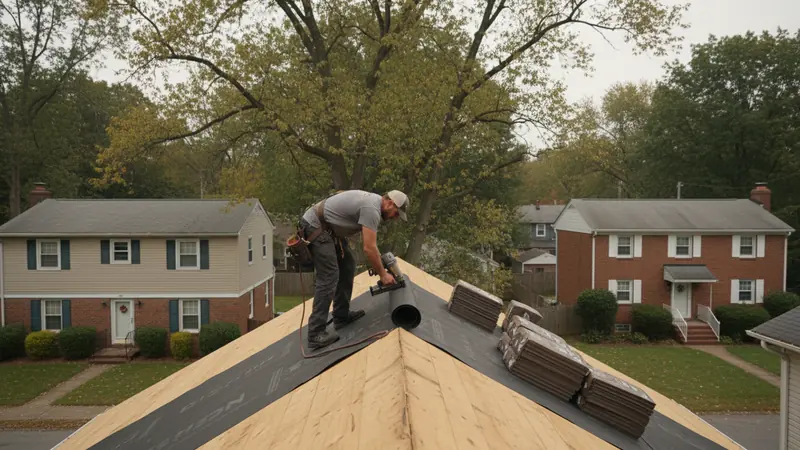
Ask your roofer to distinguish damaged shingles, deck panels, and rafters or trusses in the estimate. Calling all of these “roof repair” does not tell you whether you need a permit. It also makes competing bids hard to compare.
Source: Howard County Council, CB24-2025 introduced text, printed pages 8–9, and legislative record, recording the amended law effective 2025-09-07; introduced wording is not a substitute for the unread final text. DILP, Resources & Fees, permit-office contact, undated. Gathered 2026-09-22.
What the permit costs
The FY27 building permit schedule, effective July 1, 2026, has no separate roof-repair price. It lists these charges for single-family alterations and repairs:
| Single-family alteration or repair item | Published fee |
|---|---|
| Nonrefundable filing fee | $25 |
| Single/small room or area, 200 square feet or less | $50 |
| More than single floor or area, over 200 square feet | $100 |
| Technology fee on permits | 10% |
The filing and permit fees add up to $75 or $125, before the technology charge. We calculated those totals from the schedule. They are not quotes for your roof.
You need the county to settle two questions. What area does it charge for: replaced decking, the whole affected roof, or something else? Does the technology percentage apply to the filing fee too? The schedule does not make either clear. We have kept the published categories separate from the base totals for that reason. We cannot give you an all-in total. Ask DILP to classify your repair at 410-313-2455, option 4. Ask them to confirm the invoice too.
Source: Howard County DILP, FY27 Building Permit Fee Schedule, page 1, Council Resolution 83-2026, effective 2026-07-01. Gathered 2026-09-22.
How the application works, and how long it takes
We could not find a roof-specific permit turnaround in the primary sources we reviewed. We have no measured approval time to give you. The wait for an inspection slot does not tell you how long a building permit takes.
You must apply electronically for a residential building permit in Howard County. The miscellaneous-and-addition checklist asks you to describe the work accurately. It calls for drawings or basic dimensions and specifications. You also need the applicable contractor documents. Some projects need additional plans through ProjectDox. You may need a condominium or HOA approval letter too.
For structural roof repairs, describe the damage. Say what you will replace. Explain whether the roof's shape or supporting members will change. Ask DILP which documents your repair needs before copying an application from an unrelated remodelling job.
Keep the application separate from the contractor's start date in your written schedule. Settle who prepares any structural details. Ask who answers comments from the plan reviewer. Agree who updates the work description if opening the roof reveals more damage. The county checklist does not promise when any of these tasks will be done.
Source: Howard County DILP, Residential Miscellaneous and Addition Building Permit Checklist, revision identified as 2023-12-18; Resources & Fees, current electronic-submission requirement, undated. Gathered 2026-09-22.
The inspections
If your work needs a permit, settle which inspections you need before new roofing hides the repaired structure. Howard County's scheduling brochure lists 209 — Frame. It also lists 205 — Final Building. There is no separately named roof-sheathing booking code. Do not assume the wall-sheathing code is right for your roof.
Here is how you can book:
- 410-313-3800: automated inspection requests and results.
- Text “Schedule” to 888-297-9841. Follow the prompts.
- Once your permit is issued, you can request the next day or up to seven working days ahead. A request does not guarantee a slot.
- For a two-hour arrival window, call 410-313-1823 between 7:30 and 8:30 a.m. on the scheduled day.
- 410-313-1810: building/fire inspection questions.
Which inspection covers the exposed decking? The brochure does not say. Ask the building-inspection office which code to use. Confirm when you must leave the work exposed. The codes above come from the directory. That does not mean every roof repair needs exactly this pair of inspections.
Source: Howard County DILP, Automated Inspection Request and Permit Information System / SelecTXT brochure, posted file dated 2025-04-14; first-page footer identifies dial-up instructions dated 2024-12-27. Gathered 2026-09-22.
What the inspector is actually going to check
The county's roof-sheathing checklist asks inspectors to check more than whether new plywood is in place. They check exterior-use markings, span ratings, support spacing, panel orientation, and supported edges. Where you use fire-retardant-treated plywood, they check that it is installed properly.
For panels 5/16 inch through 1/2 inch thick, the checklist specifies 8d common nails. It gives spacing of 6 inches at edges. The other spacing is 12 inches at intermediate supports. That is the county's published checklist wording. It is not a fastening specification for every roof assembly.
For roof framing, inspectors check the rafters against the approved design and code. They compare size, span, species, grade, and spacing. Have the approved drawings and relevant truss information ready for the framing inspection.
The checklist is undated. Do not treat it as overriding current approved plans or requirements specific to your design. Use it to understand what you need to document. Settle any discrepancy with the building inspector before you install anything.
Ask for a record of the exposed damage. Ask for a record of the completed structural repair too. Photographs can help explain a change order. The county will not accept them instead of an inspection.
Source: Howard County DILP, Inspection Requirements, Residential Building — Frame and Sheathing, including Roof Framing and Roof Sheathing Inspections; no revision or effective date displayed. Gathered 2026-09-22.
Which code your job is held to — and what changes with solar
Howard County's adopted-code page lists the 2024 International Residential Code and International Building Code, with county amendments. These took effect on September 7, 2025. If your estimate cites an older edition, ask why it applies to your permit.
What you are doing matters as much as the code edition. Replacing damaged roof covering differs from rebuilding roof framing. Removing roof-mounted equipment is a different job again. If a contractor calls an added item “required by code,” ask for the applicable code or approved detail. You can check that with DILP.
Solar panels need particular care when you are reroofing. The county's residential online handout lists removing and replacing roof-mounted solar panels for reroofing as a solar-permit application example. It asks you to reference the original permit. Supporting documents include specifications, a structural letter, a roof layout, and installation certification, as applicable.
Even if the roofing is exempt, that does not settle the solar work. Ask for the proposal to name who handles the panels. Have it say who handles their county paperwork. It should also name who repairs the roof beneath them. You still need those responsibilities spelt out if you get a single combined price.
Source: Howard County DILP, Adopted Codes, code adoption effective 2025-09-07; Residential Miscellaneous & Addition Online Building Handout, solar section, file revision identified as 2025-11-05. Gathered 2026-09-22.
Historic roofs have another approval question
Howard County's Historic Preservation Commission handles exterior alterations in local historic districts. Historic approval is separate from whether you need a building permit.
The Ellicott City Historic District Design Guidelines, adopted May 7, 1998, favour keeping and repairing historic roofing. For localised replacement, they favour matching materials. They describe wood, metal, and slate roofs as worth preserving. They discourage replacing historic material you can still repair.
The guidelines treat matching roof repairs and replacement with exactly matching materials as routine maintenance. That work does not need a Certificate of Approval. Pay attention to that distinction if your bid changes the material or appearance.
Check what counts as maintenance. The current commission webpage describes its authority over exterior changes broadly. The detailed guidelines make exceptions for maintenance. We read those sources together. Do not assume every repair needs a hearing. Do not assume every replacement is exempt either. Ask historic-preservation staff which process applies at 410-313-2350 or through the county's HPC Applications page.
Before choosing a replacement product, gather photographs of the existing roof for review. Identify what you can keep. Show the proposed material and appearance. You want to know whether the quote assumes a material change before you order.
Source: Howard County, Historic Preservation Commission and HPC Applications, undated webpages; Historic District Commission, Ellicott City Historic District Design Guidelines, roofing and routine-maintenance guidance, adopted 1998-05-07. Gathered 2026-09-22.
What Howard County houses are, and what the evidence says about problems
The 2024 ACS one-year estimates put Howard County's housing stock at 126,789 units. Detached homes account for 63,578 units, or 50.1%. Attached single-unit homes account for 29,116, or 23.0%. Those figures count housing units, not separate roofs.
The largest construction-age group is 1980–1989: 27,137 units, or 21.4%. The reported margin of error for that count is ±2,154. Another 24,565 units date to 1990–1999. 17,359 date to 1970–1979.
Those estimates show that the county has plenty of older housing. They do not tell you how old the shingles are. They cannot tell you whether the decking has been replaced. Nor do they show whether your house needs a new roof. You need the roof's replacement records and an assessment of its condition, not just the house's construction date.
We found no countywide primary-source count of roof defects. We cannot say that any particular leak, ventilation fault, or decking failure dominates local service calls.
Ellicott City's guidelines do explain how gutters, downspouts, and drains protect exterior walls from water damage. They stress that these need to be adequately sized. They also need to be free of clogs and misalignment. If you find water along an exterior wall, include roof drainage in the assessment. Do not assume the shingles explain everything.
For a townhouse, settle how far the proposed work extends before accepting a bid. Check any shared responsibilities too. The county checklist calls for condominium/HOA approval where applicable. So you need to settle the paperwork as well as the repair. Neither Census counts nor a neighbourhood name tells you who owns your roof assembly.
Source: U.S. Census Bureau, ACS 2024 one-year estimates, Selected Housing Characteristics (DP04), Howard County tables published by the Maryland Department of Planning; estimates, not a roof-condition survey. Howard County Historic District Commission, Ellicott City Design Guidelines, roof-drainage guidance, adopted 1998-05-07; DILP, Residential Checklist, revision 2023-12-18. Gathered 2026-09-22.
Who is allowed to do the work
Repairing part of an existing home falls under Maryland's home-improvement licensing rules. Check that the business contracting with you holds a current Maryland Home Improvement Commission (MHIC) contractor license. You can look up its licence status through the state's MHIC webpage.
Your contractor and the crew have different licensing requirements. Maryland lets home-improvement subcontractors work without their own MHIC license if they work for an MHIC-licensed contractor. Identify the licensed business responsible under your contract. Do not assume every worker needs that same credential.
Howard County lets you act as your own general contractor for alterations and additions at your primary residence. Its guidance does not extend that exception to rentals or other properties that are not your primary residence. Filing paperwork as the owner does not settle who is responsible for the work.
For storm-related work, Maryland's MHIC notice says the license does not let a contractor act as a public adjuster. Being qualified to repair your roof is separate from having authority to represent your insurance claim.
Source: Maryland Department of Labor, What Is Home Improvement? and MHIC licensing, subcontractor, and public-adjuster notices, undated guidance; Howard County DILP, Licensed Contractor for Residential Construction, quoting local section 105.8, no separate effective date displayed. Gathered 2026-09-22.
What the work is worth, and what belongs in the quote
We found no Howard County primary-source price series for residential roof repairs. We cannot give you a supported installed-price range, emergency-call premium, or local hourly rate. The permit schedule does not tell you what a contractor should charge for labour and materials.
Maryland says the contractor cannot take more than one-third of the contract price as a deposit. They cannot accept payment before you sign the contract. State guidance requires a written, legible contract. It must describe the work and materials. It must include the contractor's identifying and license information. It also needs approximate start and substantial-completion dates. Make sure you receive a signed copy before work begins.
Ask these questions about your roof repair:
- Are you being quoted for a localised repair or replacement of an entire roof surface?
- What evidence shows where water enters or where the structure is damaged?
- What decking work is included?
- How will extra damage be priced?
- How will that extra work be authorised?
- Who handles permits?
- Who handles required inspections?
- Who handles any solar-panel work?
- What records will show the completed repair before it is covered?
We suggest these questions to help you compare quotes without inventing a local “average.” The county does not require them as contract clauses. A lower total tells you little if the bids cover different damage or leave different work for later.
Source: Maryland Department of Labor, Maryland Home Improvement Contracts, contract-content and deposit guidance, no effective date displayed. Local installed-price figures were not established from the primary sources reviewed. Gathered 2026-09-22.